| General | Hosted Sites | Civ5 | CivRev | Civ4Col | Civ4 | Civ3 | Civ2 | Civ1 | Misc | Marketplace |
![]() |
|
|
Welcome to Civilization Fanatics' Center. You are currently viewing our site as a guest which gives you limited access to our site features. By joining our free community, you will be able to participate in the discussions, search the forum, send private messages, vote in polls, upload your own screenshots to the gallery, and access many other special features. Registration is fast, simple and absolutely free, so sign up today! If you have any problems with the registration process or your account login, please contact support. |
|
|||||||
![]() |
|
|
Thread Tools |
|
|
#1 |
|
Prince
Join Date: Mar 2009
Posts: 504
|
Complete Guide to Happiness
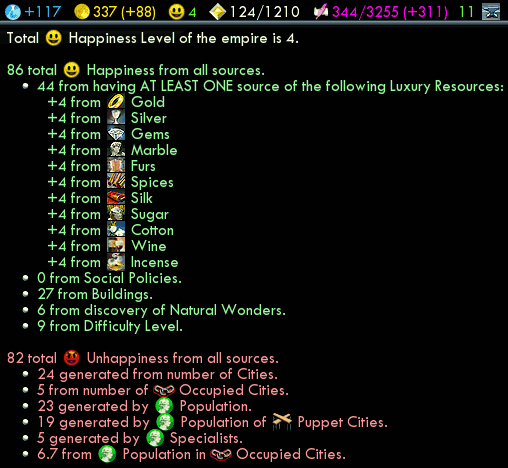
Complete Guide to Happiness All Happiness and Unhappiness Explained Introduction The status bar with happiness indicator (smiley 4) and golden age bucket (124/1210) with its hover breakdown of happiness and unhappiness sources Happiness is a measure of your citizens' contentment. In Civilization V, the happiness system is used as a primary growth and expansion limiter. The empire's happiness level is displayed on the status line at the top of the screen, with a varying face icon as a general barometer with either a green number indicating overall happiness or red unhappiness. Understanding sources of happiness and unhappiness is critical to advanced play, as maintaining a happy empire is unsurprisingly beneficial. Effects of Happiness Level There are four different possible states for happiness: Happy, Unhappy, Very Unhappy and Revolt.
Additionally, positive amounts of happiness are accumulated toward creating a Golden Age. Excess unhappiness is counted against any previous progress. This accumulation occurs only when not already in a golden age. The amount of excess happiness needed to create a golden age on standard speed starts at 500, and increases by 250 for each previous happiness golden age that has occurred and 1 percent per extra city founded. When in a golden age, every tile in the empire that produces at least one gold produces an additional gold, and cities gain a 20% production bonus. Sources of Unhappiness There are two sources of unhappiness: cities and citizens. In a standard game, each city produces 3 unhappiness and each citizen produces 1 unhappiness. Occupied cities (annexed without a courthouse) produce 5 unhappiness with each citizen producing 1.34. Large and huge maps have an 80% and 60% per city modifier, and the lowest three difficulties have a 40%, 60% and 75% modifier for both cities and citizens. Sources of Happiness Happiness can be gained and unhappiness reduced through a variety of means. Percentage unhappiness reductions are generally multiplied together, so for example each specialist in a democratic monarchic Delhi will produce only 0.125 unhappiness (0.5 * 0.5 * 0.5). General Starting Happiness
![]() +4 happiness each (+5 on settler and chieftain difficulty). There are 15 possible luxuries on standard size and larger maps, whereas some get excluded on smaller maps:
![]() +1 happiness for each Natural Wonder found. Additionally the following two natural wonders provide happiness for being within the empire's borders:
Wonders
Social Policies Unhappiness breakdown for Delhi with Monarchy, Democracy, and Population Growth 1 city (3 * 2.0 = 6) + 10 regular citizens (10 * 0.5 * 0.5 = 2.5) + 5 specialists (5 * 0.5 * 0.5 * 0.5 = .625) = 9.125, which gets rounded down to 9
Unique Abilities
Buildings The happiness provided by standard buildings cannot exceed the base unhappiness the citizens in a city produce. This happiness is referred to as local. For example, a city with population 4 with a colosseum and circus will produce no additional happiness by building a stone works or theatre. Because only the base unhappiness is considered, if all four citizens are assigned as specialists under democracy or if the leader is Gandhi, the 50% reduction will cause the citizens to only produce 2 unhappiness but the buildings will still produce their +4 happiness. The +4 happiness from both Chichen Itza and the Taj Mahal fall under the local restriction as well. ![]()
Thus through local buildings a city can typically combat the unhappiness from 9 citizens base, with an additional 1 population if stone works is available and an additional 2 if a circus is available, for a max of 12 local happiness. Egypt and Persia each have another 2 local happiness possible for a max of 14. All other unhappiness must be covered through other (global) means. General Empire Management In any empire maintaining happiness involves balancing happiness gains against population and city unhappiness, with the goal of maximizing citizen efficiency. Given the multiplier advantages present in established cities, it's generally advantageous to only plant new cities when positive happiness can be maintained or easily restored. To this end, city placement is a key factor; planting a city in the middle of a snowfield and growing it to the point of empire unhappiness is wasteful compared to letting established cities with useable tiles grow. To cover the base city + one citizen unhappiness, a new city needs only be planted near a new luxury. Planting cities near stone or marble allows for the highly efficient stone works to be built, and planting near horses allows for the efficient circus to be built. Aside from proper city placement, occasionally the best way to avoid unhappiness is to avoid growth; a city may be working an optimal amount of tiles, and a new citizen there may not be worth causing a growth hit in other cities. In addition to happiness gained through luxuries and proper city placement, social policies choices to provide happiness are a prime consideration. The optimal choices vary significantly with empire and play style, and are covered below. Managing a tall (a few cities with a high populations) empire Managing a tall empire requires aiming for raw happiness boosts and large per citizen reductions. Tall empires benefit from a limited number of raw city unhappiness hits, but also are not improved much by per city boosts. In addition, tall empires will generally have a lower total population and city unhappiness than a wide counterpart, and thus gain relatively more happiness via wonders such as Notre Dame. Key social policy choices are:
Managing a wide (many cities with low population) empire Wide empires need to cover the raw city 3 unhappiness for up to an infinite number of cities, and generally do this through per city social policy boosts. Raw happiness boosts provide less of a relative benefit. To continue sprawling, some cities may be best stuck avoiding growth at small sizes. Additionally, with their overall large populations wide empires may see a large benefit from completing the forbidden palace for -10% population unhappiness. Key social policy choices are:
Managing a puppet (a few owned cities with many puppets) empire With two maritime allies, a high production stagnated size 4 puppet
Managing Puppet Size Since puppet growth can't be controlled directly and puppets should never be grown at the expense of controlled cities, puppet growth should be controlled indirectly via exploiting tile improvements and the puppet governor's gold focus.
Managing Puppet Production Puppet production choices are based somewhat on the general state of an empire; if unhappy, puppets will choose to build happiness buildings. This can be controlled via micro using democracy and/or military caste. If the empire will briefly be falling into unhappiness anyway, temporarily forcing unhappiness (by removing garrisons or specialists) the turn before a puppet will complete a building can result in the puppet choosing to build a colosseum or theatre. Recovering from Unhappiness ![]() A major consideration when conquering is how to handle all the unhappiness newly conquered cities bring. The quick options for gaining a quick happiness boost are as follows:
Tips for picking cities to dump When deciding which cities to Sell/Gift/Raze here are a few tips for picking which cities to keep; cities that don't meet any of these criteria are probably good choices for getting rid of:
Patch version of this article: 1.0.1.383
__________________
Tried of always using the same leader/country. Check out my Leader Chooser program (for Civ IV). Constructive feedback is always welcome. Last edited by WeaselSlapper; May 09, 2012 at 07:52 AM. |
|
|
|
|
|
#3 |
|
Deity
Join Date: Mar 2008
Posts: 2,419
|
Well done,
It's missing a couple of things: Courthouses : The court house eliminates the city portion of unhappiness in the city; making the city even better than one your built even without Police State Democracy: A lot more complex than that. These are actually calculated on a per city basis with rounding before combining back together. What it really means is: A. The first specialist in every city improves happiness. B. The second specialist in a given city will have no affect whatsoever. C. The 3rd specialist in a given city will generally improve happiness. (Exception if you have Monarchy and are in the capital, in which case due to interactions with the Monarchy policy, it won't and you'll need a few more specialists.) Also, I think an unemployed citizen counts as a specialist for Democracy.
__________________
Civ III/ IV AI: I sure wish Jon would hurry up and complete his turn, he's been at it for over 1,200,000 milliseconds now.
|
|
|
|
|
|
#5 |
|
Warlord
Join Date: May 2008
Posts: 216
|
I have a question about happiness:
On high difficulties, how much extra happiness does the AI have? Is it just the default of Chieftain, or is it more? How much? |
|
|
|
|
|
#6 |
|
knows
![]() |
handicaps are deserving of their own article,
AIs have the chieftain happiness difficulty bonuses of 60% of normal, +3 starting, and +1 per luxury, in addition at the levels above prince they have 90%, 85%, 75%, and 60% of base that gets multiplied: at deity they run at 36% of normal unhappiness. |
|
|
|
|
|
#7 |
|
Chieftain
Join Date: Dec 2005
Posts: 42
|
"The 50% happiness gets rounded down on a per city basis, so an odd number of specialists will maximize happiness gained: 1-2 specialists add +1 happiness, 3-4 add +2, etc."
It gets rounded up. |
|
|
|
|
|
#8 |
|
Chieftain
Join Date: Oct 2011
Posts: 5
|
Happiness buildings & Multiplier effect
I am sure I have read some contradictory advice somewhere on this site and am hoping - as an expert on happiness you can help. Is it useful to build happiness buildings (non multiplier effect ones) in more than one city? I read somewhere, and now I can't find it, that there is no point building more than one theatre, circus etc as the +2 (or whatever) adds to the total happiness of your empire and is not cumulative from haveing multiple circuses/theatres etc. please help.
|
|
|
|
|
|
#9 |
|
Moderator
![]() Join Date: Dec 2008
Location: Sydney
Posts: 17,689
|
No, they provide happiness for each building. So building a circus in one city will give you +2 :c5happiness:, and building one in another city will give you an additional +2 :c5happiness:. Likewise, the population of each city contributes to unhappiness.
__________________
Gods & Kings Introductory Guide
|
|
|
|
|
|
#10 |
|
Gandhi of the Mongols
Join Date: Sep 2006
Location: San Jose, CA
Posts: 146
|
It's possible somebody got confused, because as noted in the main article there are cases where building a circus, theatre, etc. will have no effect on happiness - that is when the city is smaller than the total "local" happiness buildings present. They may have watched their happiness number not change when a circus was completed and not realized the real mechanic.
|
|
|
|
|
|
#11 |
|
Emperor
Join Date: Mar 2004
Location: Elmendorf, Tx
Posts: 1,281
|
The bold part is wrong. Annexing the city is what removes the per city unhappiness penalty from that city. I just tested this. Prior to annexing I had 45 unhappiness from number of cities. After annexing I only had 42 unhappiness from number of cities. Then I bought a courthouse and still had 42 unhappiness from number of cities. The courthouse itself worked exactly as it was supposed.
|
|
|
|
|
|
#12 |
|
knows
![]() |
no.
refer to the first screenshot, you will notice under unhappiness "5 from number of occupied cities"this is what happens with one annexed city as it should. when the annexed city gains a courthouse, the occupied city penalty is removed and the normal per city penalty is not regained. this is easy to view - upon annexing a puppet, happiness drops by 2 + floor(population / 3), eg a two pop city drops happiness by two, as the per city penalty goes from normal 3 to occupied 5 and the per population goes from 2 to 2.666 which gets floored back to 2. upon gaining a courthouse, happiness increases by 5 + floor(population/3), eg a two pop annexed city gaining a courthouse increases happiness by 5. the per occupied city penalty is correctly removed but not transferred back to the normal city penalty side. |
|
|
|
|
|
#13 |
|
Chieftain
Join Date: Oct 2004
Posts: 12
|
if courthouses remove the city unhappiness,and it is difficult to manage puppet growth,is there really ever a point to puppeting cities?
|
|
|
|
|
|
#14 | |
|
Deity
![]() Join Date: Jan 2011
Posts: 3,052
|
Quote:
They're great for TP spam >> Gold production. plus extra science and culture. They're really bad at producing happiness buildings, unless you're unhappy. Plus, they let you keep land+culture borders as is, thereby keeping everything without the problems of actually working them. annexing/courthouse gives you control, but also has a 5 gpt expense while also raising culture costs and Golden Age happiness targets. On top of that, you have a higher cost for national wonders (plus needing to have this city build the specific building). |
|
|
|
|
|
|
#15 | |
|
Chieftain
Join Date: Dec 2011
Posts: 6
|
Quote:
As MadDjinn pointed out, puppetted cities still count towards your territory. If you happen to gain control of your opponent's city that supplies any important strategic resource, that resource transfers over to you. Puppetting the right city can immediately deny Uranium to an opponent, and as long as the city remains standing and in your control that doesn't change. Going for a domination victory adds another aspect. Air units fighting on large landmasses require a base city and on larger maps may need to "city-hop" without taking the time or resources to fully annex or 'raze-and-replace' cities in newly conquered territory. |
|
|
|
|
|
|
#16 |
|
Warlord
Join Date: Jul 2008
Posts: 163
|
Military Caste gets mentioned but Oligarchy doesn't get mentioned. The two synergize really well because it means +1
, +2 , and a unit you don't have to pay upkeep for. I know this article is about happiness, not gold, but putting a unit in every city to gain the +1 +2 from Military Caste can possibly be economically unfeasible, especially if you want to use military caste in the classical era while capturing lots of cities. If it's economically unfeasible, you can't implement the policy in the first place. Basically a waste of a policy.Furthermore, If you compare a garrisoned city in a civilization with Military Caste to a coliseum, the coliseum provides twice the amount of happiness for the same upkeep in the classical era. As upkeep per unit gets more and more expensive as the eras go by, it becomes more and more inefficient to place units in cities strictly for happiness (with a +2 kicker). Oligarchy, on the other hand, removes the largest negative of applying Military Caste. As a bonus, city attacks are stronger due to Oligarchy. Normally this is negligible unless you get ambushed, but having a large army and many enemies due to the army's size + diplomatic penalties from declaring war on other civ's friends makes the chances of ambush higher than having moderate army size and a less aggressive foreign policy.Also, even if an economy is healthy, Oligarchy can make Military Caste even more attractive and the gold saved can buy courthouses/happiness buildings or even more units. Lastly, there's a diplomatic boost/penalty to using Military Caste. If you're putting units in all your cities, this can seriously deter other civs into declaring war on you due to a large army. Sometimes it will even make some civilizations fear you. On the flip side, it can cause an arms-race as other civs try to keep up (which can be a good thing -- it means they're not improving their cities). Also, some civs won't like you for having such a large army -- Mongolia is a shining example -- and you'll get denounced. |

|
|
|
|
|
#17 |
|
Prince
Join Date: Sep 2007
Location: Ireland
Posts: 520
|
Fair points about Oligarchy, but I really don't think that buffing Military Caste is worth the social policy pick. The extra gold saved won't compare to the extra happiness from something like Organized Religion. Given that it's comparatively easier to come by gold that it is to come by happiness prioritizing gold doesn't make much sense. You also have to bear in mind that unless you can provide for the unit upkeep anyway that unit is going to be stuck inside that city (or only allowed out so long as the treasury can maintain the deficit).
It's also a little unfair to compare Military Caste (a social policy) to a colosseum (a building). The two aren't really comparable in the sense that they're not competing with each other. It isn't a case of Military Caste or Colosseums, it's a case of Military Caste or a different social policy and Colosseums or a different building. The question is whether or not buffing Military Caste is better than Military Caste with an independent social policy. However, if you're going for the Tradition finisher with Military Caste then yes, you do have a point. There's a nice synergy there that will save you a bit of gold.
__________________
V - Marathon/Standard/Immortal. Check out my standard sized world map for Civ 5: Gods and Kings! |
|
|
|
|
|
#18 |
|
Chieftain
Join Date: Oct 2009
Posts: 5
|
I am confused about the whole local happiness from buildings thing. I know that the happiness generated from certain buildings, specifically the Colosseum line, can't exceed the total population. But does this include walls, castles, etc from professional army or universities, observatories, etc from humanism? For example would a city with a population of 4 and the obvious SPs "produce" more than 4 happiness from buildings if it had the entire colosseum line and all the defensive buildings and humanist buildings?
There would of course be no benefit from the Stadium but wouldn't everything else add to the empire's total happiness? |
|
|
|
|
|
#19 |
|
Gandhi of the Mongols
Join Date: Sep 2006
Location: San Jose, CA
Posts: 146
|
This is also a burning question for me (though obviously not quite burning enough to stop conquering the world/travelling to AC/awing the world/paying off the world long enough to do the experiment). Stating it more simply, for buildings that give happiness because of a social policy is the happiness "local" or "global"?
|
|
|
|
|
|
#20 |
|
Chieftain
Join Date: Oct 2009
Posts: 5
|
I did some quick tests and I've found them to be global. At least in the case for the buildings I tested (walls, castle), so I'm going to assume other buildings like this are global as well. In short my city of 4 population was producing 7 happiness from buildings.
|
|
|
|
![]() |
| Bookmarks |
| Tags |
| civ5 war academy, happiness, unhappiness |
|
| Thread Tools | |
|
|