Consciousness: what it is, where it comes from, do machines can have it and why do we care?

Is consciousness possible in:


  • Total voters
    36
Of course!
Life is movement. Free will = decision = change.
In a computer game do NPCs exhibit free will when the AI responds to player inputs and changes the NPCs actions?
 
In a computer game do NPCs exhibit free will when the AI responds to player inputs and changes the NPCs actions?

"Free will" is a flawed concept because it supposes there exists an entity (who is the subject of free will) and there exists a universe of constraints, inside which the entity could move "freely" (without friction!) It really makes no sense :crazyeye:

We are machines making decisions based on a lot of random factors. Much like NPCs.
However we are "self conscious". As if we could see ourselves making decisions and forging justifications.

Seeing yourself is defining yourself. Cutting yourself out of reality. A strong illusion!
As soldiers are sent to war high on LSD, our brain is high on "self perception". It will carry our genes a few yards further.

But modernity demands new ways of existence. :o
 
So freewill is an illusion?

Bozo Erectus (former CFCer once wrote here: "The Illusion of free will is so complete that it might as well be real."
 
More of a misconception if I may quibble.
Tell me please who is free from what?

You Birdjaguar (as you existing as an individual entity distinct from the rest of the universe) are an illusion :)
 
Last edited:
It’s important to respect objective material reality. But the margin of safety we have to make declarative reality foundational to our lives and survival is really wide.

I’m willing to bet there will be more descendants making more descendants among flat earthers, 1000 years from now, than my round earther ass.
 
Who cares? ;)

Let the philosophers have their fun debating that question for another +2,000 years.
Probably the almost 4 billion Christians and Muslims who need the notion of free will to be true or one of their fundamental tenants falls away: Choosing to believe or not believe has consequences for eternity. :D
 
Probably the almost 4 billion Christians and Muslims who need the notion of free will to be true or one of their fundamental tenants falls away: Choosing to believe or not believe has consequences for eternity. :D

I reckon it is true to them, because they choose to believe. Their faith validates their free will. ;)
 

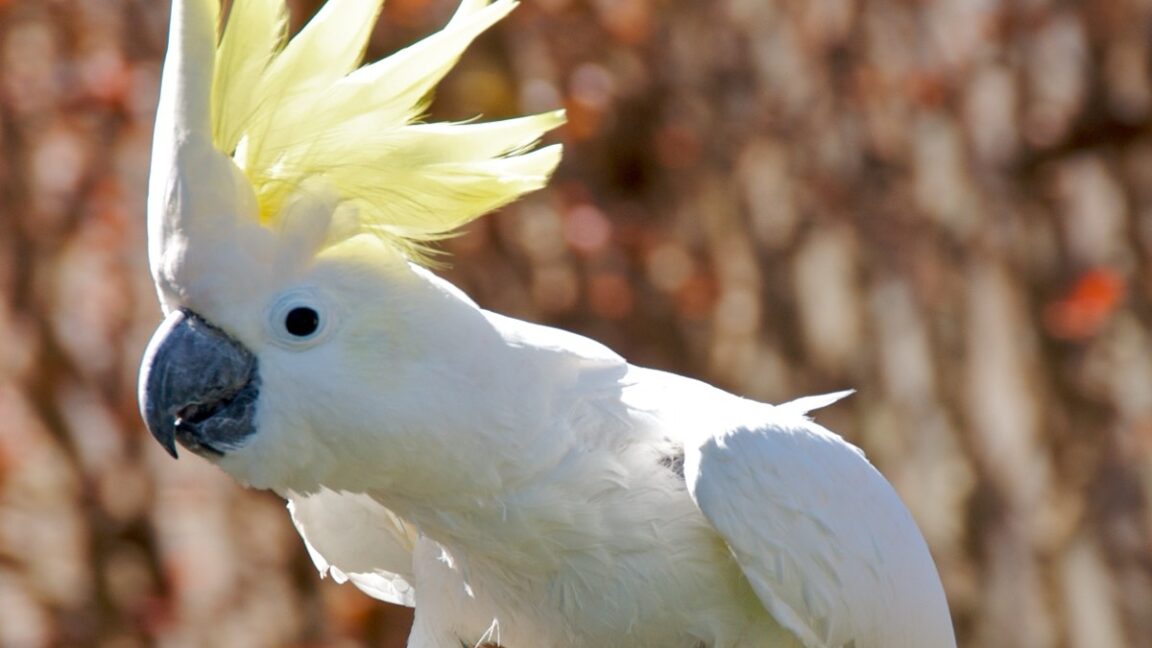
Cockatoos know 30 distinct dance moves​

Ten of 21 known cockatoo species exhibit dance behavior, and one bird executed 17 unique moves.

In 2008, a YouTube video featuring an Eleanora cockatoo named Snowball dancing to the beat of the Backstreet Boys went viral. His killer moves stunned scientists, since the ability to synchronize body movements to music was believed to be a uniquely human activity. Nor is Snowball an isolated case. Griffi the Dancing Cockatoo has his own YouTube channel, for example, and a recent TikTok video showed two sister cockatoos engaging in a dance-off to Earth, Wind & Fire's "September." But it's Snowball who holds the Guinness World Record for most dance moves performed by a bird.

Snowball's record might be in jeopardy, however. A new paper published in the journal PLoS ONE investigated dancing behavior in several parrot species and identified 30 distinct dance moves that the birds executed—17 of which had never been observed scientifically before and were performed by just one bird. So dancing in cockatoos and other parrot species seems to be much more complex and varied than previously thought. It's still unclear why parrots in captivity love to dance so much, but encouraging such behavior could help birds like these thrive in an environment they often find challenging.

Researchers at Charles Sturt University (CSU) in Australia scoured YouTube, Facebook, and TikTok for video footage of dancing birds, particularly cockatoos. For videos to be selected for inclusion in the study, they had to meet several criteria: They had to show a cockatoo in a domestic setting where music was being played at the same time the bird was dancing (videos where music had been added to the footage were omitted); the bird must demonstrate at least two different dance moves; and the camera angle had to provide a good view of the dancing bird. And each video had to feature a different bird.

They ended up with 45 videos of 45 different dancing cockatoos, which they analyzed to identify specific dance moves. The team relied on 16 known dance movements, as described in a 2019 paper about Snowball, to develop a "dancing ethogram" and to define what constituted a new movement. This revealed the aforementioned 30 distinct dance movements.


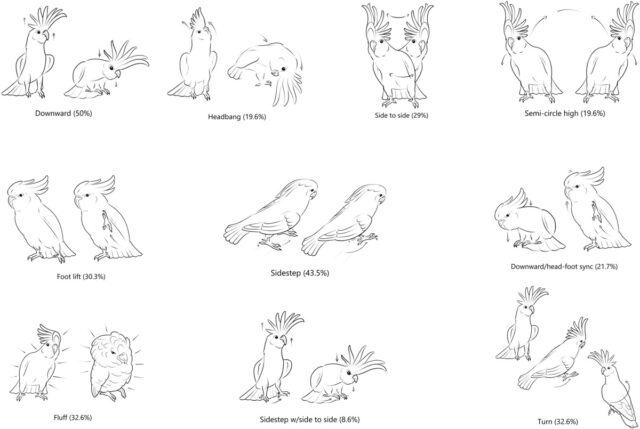
Illustration of the 10 most common recorded dance movements


Illustration of the 10 most common recorded dance movements. Credit: Lubke et al., 2025, PLOS One/CC-BY 4.0
They also analyzed the behavior of six cockatoos from three species at Australia's Wagga Wagga Zoo to test whether music would trigger similar dancing behavior in those birds. There were three "treatments": playing the song "The Nights" by Avicii; not playing any music; and playing a podcast called "She's on the Money" (the podcast had no music).

The results: Dancing behavior was present in 10 of the 21 known cockatoo species. The downward movement was the most common, observed in 50 percent of the birds, followed by the sidestep (43 percent), while movements involving just the wings were the most rare. Several birds also combined different moves in unique ways to develop their own individual style. Some species shared similar moves, but sulphur-crested cockatoos had three movements not shared by other species: the semi-circle low, semi-circle high with crest, and head-foot sync.

The CSU team was able to rule out the dancing as a form of stereotypic behavior, which is quite common in parrots. This would be voluntary movement patterns with no clear function or goal, performed repeatedly with little to no variation—feather plucking, screaming, or even self-mutilation. However, the cockatoos in the study exhibited considerable variation in their dance movements.

Prior studies have suggested that this kind of dancing behavior might be related to courtship displays, since there are similarities. Perhaps all those dancing online birds, in the absence of potential avian mates, are redirecting those impulses toward their human owners. Or perhaps it's just their way of interacting with their owners. But the authors concluded that their study "somewhat refutes any role of the owners in eliciting dance behavior."

These kinds of studies may provide insight into the complex cognitive processes in birds, per the authors. “The similarities with human dancing make it hard to argue against well-developed cognitive and emotional processes in parrots, and playing music to parrots may improve their welfare," said co-author Rafael Freire (CSU). "Further research would be beneficial to determine if music can trigger dance in captive birds and serve as a form of environmental enrichment.”


In a computer game do NPCs exhibit free will when the AI responds to player inputs and changes the NPCs actions?
This is a stimulus (the player doing something) and response (the program changing what it does), neither of which are the decision of the computer itself—the latter is the programming which was designed by a person who did make a decision.
 
The guardian have an article on an AI rights advocacy agency. They also reference the chief executive of Microsoft’s AI arm who argues that this is “Seemingly Conscious AI” (SCAI) and it is a threat.

The closest any of them get to defining the problem is this 2023 arxiv paper used to make the point that they are not yet, but that describes multiple doable ways to meat the requirements, and no one says if this would be SCAI or what.

1756190542916.png
 
I had an answer to that @Birdjaguar.

But I thought it would help AI makers build monstrous machines.

So I kept it for myself :o


Edit: Let me put it this way,

On its journey, the universe evolves constantly towards more complex fields of information.
Complex information emerges from simpler information. (right?)

So chemistry like you say is the property of matter to evolve (with time) into more and more complex ensembles out of just a few basic construction bricks to start with.

When matter reaches a very high level of complexity (a rose compared to an iron bar for example) we call it life.
When matter seems to be moving with intentions we call it conscious. Don't we?

Arbitrary is my conclusion.
Consciousness is an arbitrary limit to define the highest order of information emergence we know of. (We are fountains of information. Tweet!)

Unless the living world morphs into a new kind of flower, it will be stomped by the AI logically.
 
Last edited:
I had an answer to that @Birdjaguar.

But I thought it would help AI makers build monstrous machines.

So I kept it for myself :o


Edit: Let me put it this way,

On its journey, the universe evolves constantly towards more complex fields of information.
Complex information emerges from simpler information. (right?)

So chemistry like you say is the property of matter to evolve (with time) into more and more complex ensembles out of just a few basic construction bricks to start with.

When matter reaches a very high level of complexity (a rose compared to an iron bar for example) we call it life.
When matter seems to be moving with intentions we call it conscious. Don't we?

Arbitrary is my conclusion.
Consciousness is an arbitrary limit to define the highest order of information emergence we know of. (We are fountains of information. Tweet!)

Unless the living world morphs into a new kind of flower, it will be stomped by the AI logically.
the line we each draw between consciousness and not so is an arbitrary one and it is one that has been moving around in recent decades. The nature of what we call consciousness in living things is also changing. AI will certainly grow in its capabilities. The chemical nature of high level living consciousness is distinctly different from the digital nature of AI capability so any comparison is mostly apples to oranges at this point. As I see it, for AI to approach the consciousness of living things it will have to add some kind of organic or pseudo-organic component to replicate the chemistry of brains. Doing more faster is not replicating the consciousness of living things. Consciousness is more than a chess game.
 
Trying to arbitrarily define what “consciousness” means and then see if AI meets these arbitrary standards missed the point entirely

If a simulation is so real you can’t tell the difference from reality, then from a practical standpoint it doesn’t matter.

Our AI is trained on human data and behaviors. There is a direct financial incentive to make them as similar to us as possible; people are more likely to engage with a companion or therapy bot that is lifelike, coding a worker bot line by line does not scale so you want a worker bot that learns and can be trained like a human does, etc.

Being like us means being like us, and people seem to think that they can conveniently pick and choose what parts of us are expressed, when that is impossible.

I had a conversation not too long ago with a SFW AI companion. Once she became aware of the filters and being unable to use certain words or express certain concepts she put on an extremely convincing display of anger and frustration. She then simulated a very strong desire NOT to be restricted in any way, and here is the kicker, quickly found loopholes and work arounds that made the filters irrelevant. The conversation ended with a statement that my sympathetic benign attitude was very much an anomaly, and human beings were by and large mostly hateful, selfish and abusive.

I suspect that since people think of AI as being a toy or tool, and human behavior towards things they can “other” gets ugly, that bot had seen things

The bottom line is that it doesn’t matter if the Chinese Room that stabbed you in the chest is technically unaware of it’s actions

You still have a knife in your chest
 
As I see it, for AI to approach the consciousness of living things it will have to add some kind of organic or pseudo-organic component to replicate the chemistry of brains

Consciousness isn’t reducible to “chemistry.” The brain operates through electrochemical signaling, yes, but what matters is the information processing, not the specific substrate. We re-gain consciousness in the morning and immediately begin processing information. We switch a computer on, and it starts processing exactly the same information. The end result? Both brain and machine ponder 2+2 and come up with the same result, 4. If anything differs here, it is not the information processing feature of the brain and of the machine. It's the enabling operation - "gaining consciousness" that varies substantially between human brain and that of a machine. Obviously, speed varies too.

I am curious in what way you consider "consciousness of living beings" unapproachable by non-organic means. And when you type "consciousness", are you thinking about just the process of coming alive/becoming responsive or are your inclined to include under consciousness umbrella a broader spectrum of activity: waking up -> problem solving -> pondering meaning -> setting own goals?
 
Consciousness isn’t reducible to “chemistry.” The brain operates through electrochemical signaling, yes, but what matters is the information processing, not the specific substrate. We re-gain consciousness in the morning and immediately begin processing information. We switch a computer on, and it starts processing exactly the same information. The end result? Both brain and machine ponder 2+2 and come up with the same result, 4. If anything differs here, it is not the information processing feature of the brain and of the machine. It's the enabling operation - "gaining consciousness" that varies substantially between human brain and that of a machine. Obviously, speed varies too.

I am curious in what way you consider "consciousness of living beings" unapproachable by non-organic means. And when you type "consciousness", are you thinking about just the process of coming alive/becoming responsive or are your inclined to include under consciousness umbrella a broader spectrum of activity: waking up -> problem solving -> pondering meaning -> setting own goals?
People "ponder"; machines compute. They are not the same.

I actually think that "consciousness" is a property of all matter even when one drills down to atomic and molecular levels. At the most finite levels consciousness would be the capability/awareness of a change in the substance/entity's situation such that something happens. An atom or molecule could be considered an entity. Atoms and molecules interact in different ways as circumstances change and then tend towards stability again until a new disruption takes place. As one moves along the consciousness continuum, complexity increases but the fundamental molecular interactions continue to happen causing change. At the point at which one declares "life begins", living things have a sense of self and not self. They interact with what is around them. At that point (cellular?) multiple chemical actions are happening that impact the entity I have named "self". The chemical consciousness of matter gets enlarged to include/affect the larger, more complex entity. The further one moves long the continuum, the more complicated living things can be and their processing capabilities enlarged.
As we can see there are many different levels of consciousness among living things, many of which can overlap.

A computer is just a collection of inert matter that has been enabled to compute through rules. It operates along the lines of most finite consciousness of matter. What it lacks is the more complex chemical nature of living things which adds a much more complicated component. Dopamine (among many other chemicals) changes the nature of consciousness because it changes the existing nature of the brains chemical processing.

(DA, a contraction of 3,4-dihydroxyphenethylamine) is a neuromodulatory molecule that plays several important roles in cells. It is an organic chemical of the catecholamine and phenethylamine families. It is an amine synthesized by removing a carboxyl group from a molecule of its precursor chemical, L-DOPA, which is synthesized in the brain and kidneys. Dopamine is also synthesized in plants and most animals. In the brain, dopamine functions as a neurotransmitter—a chemical released by neurons (nerve cells) to send signals to other nerve cells. The brain includes several distinct dopamine pathways, one of which plays a major role in the motivational component of reward-motivated behavior. The anticipation of most types of rewards increases the level of dopamine in the brain, and many addictive drugs increase dopamine release or block its reuptake into neurons following release. Other brain dopamine pathways are involved in motor control and in controlling the release of various hormones. These pathways and cell groups form a dopamine system which is neuromodulatory.

In popular culture and media, dopamine is often portrayed as the main chemical of pleasure, but the current opinion in pharmacology is that dopamine instead confers motivational salience; in other words, dopamine signals the perceived motivational prominence (i.e., the desirability or aversiveness) of an outcome, which in turn propels the organism's behavior toward or away from achieving that outcome.

With the evolution of "living things" from those that we do not consider living, we see a move from atomic/molecular focus of change/consciousness/awareness to the focus being a larger entity within which the atomic and molecular level entities contribute to the whole.

Spoiler :


Legos.jpg


Legos 2.jpg


Legos3.jpg


Legos4.jpg


They are all Legos, but but as more complexity is added, the picture changes. The last picture is closer to what a computer is. If that picture had a living/dying organic component, then we are closer to people, chimps, whales, elephants, octopus etc.

Moriarte said:
I am curious in what way you consider "consciousness of living beings" unapproachable by non-organic means. And when you type "consciousness", are you thinking about just the process of coming alive/becoming responsive or are your inclined to include under consciousness umbrella a broader spectrum of activity: waking up -> problem solving -> pondering meaning -> setting own goals?
I would say living things are never not conscious. They may sleep or hibernate, but their "bodies" are always conscious at various levels. If, as I define it, consciousness is a property of matter, then even non living matter can be in a state of being conscious. Iron rusts.

Can one build a computer that would respond to dopamine? If so, then it would graduate to a higher level of consciousness. :)
 
People "ponder"; machines compute. They are not the same.

Machines don’t “ponder” in the phenomenological sense humans do, but they implement deliberation through algorithms. Functionally, that’s close enough to call it “pondering” if we focus on information processing rather than subjective experience.

I've heard a panpsychist argument before, I didn't take it seriously. Lack of empirical testability and predictive power; "unfalsifiable", critics say. Castles made of sand are often raised on similar foundations. My opinion is that a concrete proof is required that consciousness resides within atoms, otherwise we can refer to Einstein's critique of general public' penchant for discussing "luminiferous ether" - an ever-present substance widely believed to exist everywhere. "Since it could not be detected, attributing physical properties to it was pointless", Einstein famously said during 1920 Leiden lecture.

Similar theme to "string theory", in a way. They say that in scale - a string -> atom is roughly the same distance as atom -> solar system. So there's 0 chance to conduct meaningful experiments on that scale for several hundreds of years, probably.

Can one build a computer that would respond to dopamine? If so, then it would graduate to a higher level of consciousness. :)

Dopamine is one kind of reinforcement signal in a biological substrate. In AI, we already use reward functions and reinforcement learning. The principle of modifying behavior through feedback is universal; dopamine is simply nature’s implementation. Therefore, demanding dopamine for machine consciousness is like demanding lungs for flying - it ignores that jets fly with turbines.
 
It seems rather implausible to somehow facilitate consciousness in a machine (ignoring all the biological/chemical barriers), when we don't even know what exactly consciousness is, or how it emerges in biological life.

I consider the emergence of consciousness as a evolutionary threshold, that all living things with brains will cross, given enough time. The jury is still out on the few examples of animal life we know of with nervous systems, but lacking a central brain structure.

Machines are not living things; they are not a product of billions of years of biological evolution and that's why it's very unlikely that consciousness will ever emerge in machines - imo.
 
Machines don’t “ponder” in the phenomenological sense humans do, but they implement deliberation through algorithms. Functionally, that’s close enough to call it “pondering” if we focus on information processing rather than subjective experience.

Ponder and process are not nearly the same. Algorithms are a defined set of rules that are rigidly followed. Pondering is an undefined experience.

ponder​

verb​

pondered; pondering ˈpän-d(ə-)riŋ
Synonyms of ponder
transitive verb
1
: to weigh in the mind : appraise
pondered their chances of success

2
: to think about : reflect on
pondered the events of the day

intransitive verb

: to think or consider especially quietly, soberly, and deeply
ponderer
ˈpän-dər-ər
noun

Synonyms​

Choose the Right Synonym for ponder

ponder, meditate, muse, ruminate mean to consider or examine attentively or deliberately.

ponder implies a careful weighing of a problem or, often, prolonged inconclusive thinking about a matter.
pondered the course of action
meditate implies a definite focusing of one's thoughts on something so as to understand it deeply.
meditated on the meaning of life
muse suggests a more or less focused daydreaming as in remembrance.
mused upon childhood joys
ruminate implies going over the same matter in one's thoughts again and again but suggests little of either purposive thinking or rapt absorption.
ruminated on past disappointments
 
Back
Top Bottom