• 📚 Admin Project Update: I've added a major feature to PictureBooks.io called Avatar Studio! You can now upload photos to instantly turn your kids (and pets! 🐶) into illustrated characters that star in their own stories. Give it a try and let me know what you think!

SCOTUS news and opinions

Definitely made a pretty penny with how big his platform was, but yeah, he's screwed. SCOTUS would be insane to touch this case with a ten-foot pole.

Alex Jones is hosed.


He is going to have to sell a lot of supplements to pay off his debt!
 
Onion gets his company!!
 

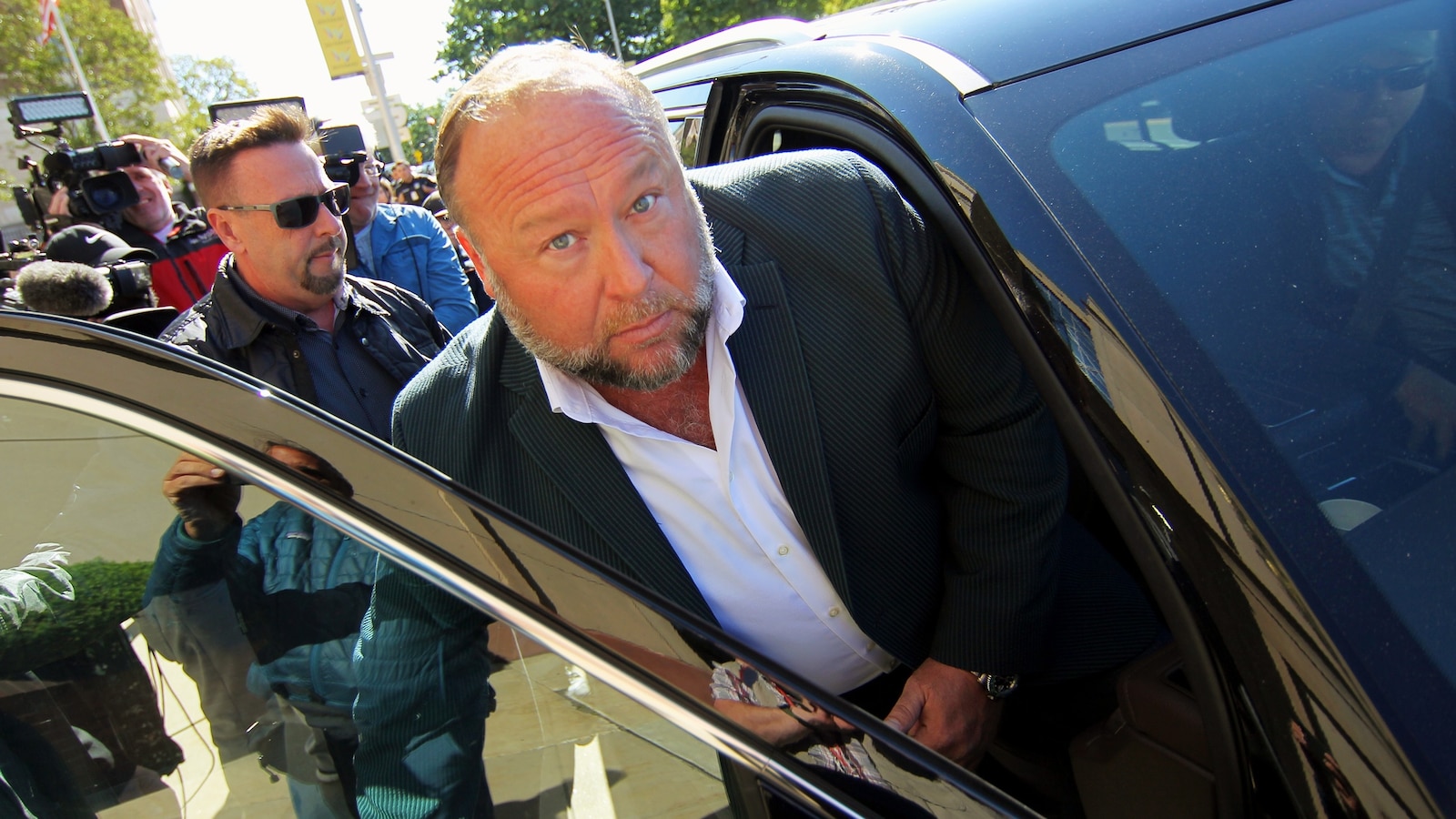
Alex Jones asks US Supreme Court to block billion-dollar defamation ruling against him​

Right-wing conspiracy theorist Alex Jones has asked the US Supreme Court to put on pause the nearly $1.5bn (£1.1bn) defamation judgment against him that is forcing the sale of his Infowars media company.

Jones was ordered to make the payout in 2022 for claiming the 2012 mass shooting at Sandy Hook Elementary School was a hoax.

He has asked the high court to prevent Infowars from being sold to the satirical news site The Onion in order to fund judgment against him, arguing that it will cause irreparable harm to him and his audience of 30 million.

The sale to The Onion, backed by the families of victims of the Newtown, Connecticut, shooting, was rejected last year after a bankruptcy auction.

Jones is asking the justices to put the judgment on hold while deciding on an appeal he has filed. The court is expected to consider his application on Friday in private.

Attorneys for Jones and his company, Free Speech Systems, characterized him as a media defendant in their court filing on Thursday.

They argued that Jones, who founded the platform in 1999, should enjoy the same free speech protections under the First Amendment of the Constitution that journalists have, according to court documents filed on Wednesday.

They also said the record-breaking payout and the shuttering of his platform would have a "chilling effect" on similar media figures.

"Jones believes this Court will unanimously recognize that a failure to reverse this case will mean all journalists will realize that they could be found liable for huge defamation awards, especially in ideologically divergent geographic regions," they wrote.

That, in turn, could keep journalists "from publishing for fear of being hauled into court there facing a 'trial by sanction' in which the First Amendment is superfluous and debilitating damages can be awarded", they added.

After a Connecticut court ruled against him in the defamation case, Jones filed for bankruptcy protection in Texas and Infowars was put up for auction so that he could pay the families of victims of the Sandy Hook mass shooting, who had brought the suit.

Last year, The Onion made a bid to buy the Infowars website but the sale was rejected by a US bankruptcy judge in December. However, the judge also rejected Jones' claims that the bankruptcy auction was plagued by "collusion."

In his Wednesday application, Jones told the highest court in the country that he will experience "irreparable injury" if Infowars is sold to its "ideological nemesis" and intentionally "destroyed".

Twenty children and six adults were killed in 2012 when a gunman rampaged through the primary school in Newtown, Connecticut, firing a semi-automatic rifle before killing himself.

Jones, who positions himself as "a steadfast proponent of questioning mainstream narratives from the government and mainstream news media", claimed for years that the massacre was a "staged" government plot to take guns from Americans and that "no-one died".

He called the parents of victims "crisis actors" and argued that some of them never actually existed.

In a separate defamation trial in Texas, Jones later acknowledged the attack was "100% real".
https://www.bbc.com/news/articles/cy856qxzq01o

SCOTUS rejects Alex Jones's appeal.

Other rejections:

The justices declined to hear an appeal from a group of Colorado parents seeking to sue their public school district over a policy that allegedly allows children to pursue gender transitions, and be supported by school staff, without any parental notification.

In a statement, Justice Samuel Alito concurred with the decision, saying the case was an imperfect "vehicle" for examining the core legal question; but he urged the court to look for other opportunities to take up the "troubling -- and tragic -- allegations in the case."

In another case, the court rejected an appeal from a group of unnamed minors and their families who had sued the app Grindr for marketing to children, recommending them to nearby adults for sex and allegedly facilitating trafficking.

Plus, it declined to take up a closely-watched California case challenging Food and Drug Administration regulations governing the use of stem cells to promote healing through new forms of treatment as well as a conservative group's challenge to Department of Homeland Security's authority to issue temporary work permits to immigrants who entered the country unlawfully without express consent from Congress.

 
In the hearing today in Louisiana v. Callais, the 6 conservative justices seemed primed to finally end the rest of the VRA and officially legalize racial discrimination in drawing House district maps. This would be something like a 19 seat swing in favor of Republicans in next year’s midterms, and essentially guarantee permanent GOP control of the house for the time being.

Alito + Thomas are def in, Kavanaugh + Roberts have written and voiced historically opinions that agree. Barret has too - although it wouldn’t shock me if the conservative justices bargain for a 5-4 ruling in which she joins the liberals to try to temper some anger.
 

US Supreme Court lets Trump administration require gender at birth be listed on passports​

The US Supreme Court will allow the Trump administration to require all new passports to display an individual's biological sex at birth, for now.

The conservative-majority court on Thursday froze an order from a lower court in Massachusetts that had stopped the US government from changing its policy while the legal process plays out.

"Displaying passport holders' sex at birth no more offends equal protection principles than displaying their country of birth," the court said.

On his first day in office, Trump signed an executive order recognising only two sexes, leading the US to issue passports with just male or female designations, based on a person's sex recorded at birth.

The Biden administration allowed people to self-select their gender on passports and add a third gender option - X - to the government document, which is issued by the State Department.

The win for the Trump administration - the latest on the high court's emergency docket - means that individuals can no longer show their chosen identity on new or renewed passports in the near future.

The order said that the government is "merely attesting to a historical fact without subjecting anyone to differential treatment".

The Supreme Court also said the administration "is likely to succeed on the merits", indicating the justices are inclined to issue a final ruling upholding the requirement when the case reaches them.

The three liberal justices dissented.

The plaintiffs in the case are arguing that the limitations in the gender field amounts to harassment and can lead to violence against transgender individuals.
https://www.bbc.com/news/articles/c2em442nyrwo
 

Supreme Court to weigh longshot bid to overturn same-sex marriage precedent​

The Supreme Court will meet behind closed doors Friday to consider a longshot bid to overturn its decade-old same-sex marriage precedent, an appeal that is churning fear among some LGBTQ advocates even though the justices themselves have repeatedly signaled little appetite for reopening the landmark decision.

The pending appeal comes from Kim Davis, a former county clerk from Kentucky who refused to issue marriage licenses after the Supreme Court’s blockbuster 2015 decision, Obergefell v. Hodges, allowed same-sex couples to legally marry. Davis, who has fought her case for years, has directly asked the court to jettison that decision.

“The time has come,” Davis argued in a recent filing, for a “course correction.”

The Supreme Court will meet Friday, like it often does this time of year, to consider which appeals it will hear in coming months and which it will deny. The Davis appeal is one of dozens of cases the justices will consider in that private meeting, and the court could announce as soon as Monday what it will do with the case. It could also hold the appeal for weeks, which often happens when one or more justices want to write an opinion about a decision to deny a case.

“I am very concerned,” James Obergefell, the namesake of the landmark precedent, told CNN this week. “At this point I do not trust the Supreme Court.” It is true that today’s Supreme Court is different – and far more conservative – than the one that decided Obergefell a decade ago. Justice Anthony Kennedy, the key swing vote who authored that decision, retired in 2018 and was replaced by Justice Brett Kavanaugh, a far more reliable vote for conservative outcomes. Justice Ruth Bader Ginsburg, a liberal icon who was also in the Obergefell majority, died in 2020 and was succeeded by Justice Amy Coney Barrett, a conservative.

But despite public criticism of the opinion from a few conservative justices – including a sharply written concurring opinion three years ago from Justice Clarence Thomas, who called on his colleagues to “reconsider” same-sex marriage – plenty of other signs suggest the court is not ready to rethink the issue so soon after deciding it.

As she promoted a new memoir this fall, Barrett was repeatedly asked about Obergefell. While she repeatedly swerved around those questions, she told the New York Times last month there are “very concrete reliance interests” at stake when it comes to same-sex marriage. One of the factors the Supreme Court considers when weighing the possibility of overturning a precedent is whether Americans have come to rely on the decision. In the case of same-sex marriage, those considerations could include factors like child custody and financial planning.

Justice Samuel Alito also discussed the 2015 decision last month, criticizing it as inconsistent with the originalist legal philosophy that the court’s conservatives today widely embrace. And yet Alito, who dissented in Obergefell, was careful to caution his audience not to read too much into his words. “In commenting on Obergefell, I am not suggesting that the decision in that case should be overruled,” Alito said during a lecture in Washington, DC. “Obergefell is a precedent of the court that is entitled to the respect afforded by the doctrine of stare decisis,” Alito said, using the Latin term for the principle of the importance of adhering to precedent.

The Obergefell decision prompted a massive celebration outside the Supreme Court on the day it was decided. That evening, the White House was lit up with rainbow-colored lights. Many same-sex couples rushed into courthouses the next day to wed. Nearly 600,000 same-sex couples have since married, according to the Williams Institute at the UCLA School of Law.

But some religious conservatives saw the decision as a betrayal. Davis, who at the time was the clerk of Rowan County in Kentucky, cited her religious objection to same-sex marriage as justifying her decision to withhold marriage licenses to all couples. She was sued by multiple couples in the county, and a jury awarded $100,000 in damages plus far more in legal fees. After a federal court found she had violated a court order to issue licenses, Davis was also thrown in jail for several days.

While virtually all of the attention around the Davis appeal has focused on her request to overturn Obergefell, the bulk of her case deals with a series of less dramatic questions. In appealing the damages verdict, Davis argues that the First Amendment’s religious protections should shield her from legal liability, particularly since she is no longer a public official. The 6th US Circuit Court of Appeals rejected that argument.

The Supreme Court could, in theory take up that technical – though still important – question and decline Davis’ request to consider overturning Obergefell. It takes four justices to grant an appeal, but that number belies a practical reality. It takes five for a majority, which means even if there are four justices who want to hear a case, they must consider whether they can find a fifth vote to win.

Perhaps the more important question is whether the Davis petition is an opening salvo in a longer campaign against Obergefell that will slowly build, just like the ultimately successful effort by conservatives to overturn Roe v. Wade. On the one hand, cultural and political winds have shifted significantly on gay marriage in past decades. Three years ago, Congress passed a federal law protecting same-sex and interracial marriage with bipartisan support. But opposition remains among some religious groups, which have enjoyed significant success at the Supreme Court in recent years.

“If not this case, it’s going to be another case,” said Mathew Staver, the founder and chairman of Liberty Counsel, a religious legal group representing Davis. “In my view, it’s not a matter of if but when it will be overturned.”

Mary Bonauto, a veteran civil rights attorney at GLAD Law who argued the Obergefell case, said she wasn’t surprised by that view. “I’m not taking my eye off this issue, and neither is my organization,” Bonauto said. “You can never really rest on your laurels because other forces just don’t give up.”

 
It is to my mind perfectly possible for SCOTUS to rule in favour of Kim Davis without overturning same sex marriage.
 
How so?
 
My understanding is that when she took up her job as registrar, it did not involve marrying same sex couples.

If the state legalises same sex marriage, it might very reasonably make it a condition that all
newly employed registrars shall undertake registration of both different sex and same marriages.

What is not clear is that a state employer has a unilateral right to de facto change her job description.

The state employer could take two lines:

(a) only allocate the registration of different sex marriages to her, and the employer's problem disappears when she retires.
(b) declare that the position of a different sex only registrar has been abolished, she is therefore redundant and pay her off.

Neither action requires any court action. The thing is the pro-gay marriage lobbyists wanted an avoidable legal fight.
Now they may well get that, but with a different SCOTUS from before, which has a number of interesting options.
 
My understanding is that when she took up her job as registrar, it did not involve marrying same sex couples.

If the state legalises same sex marriage, it might very reasonably make it a condition that all
newly employed registrars shall undertake registration of both different sex and same marriages.

What is not clear is that a state employer has a unilateral right to de facto change her job description.

The state employer could take two lines:

(a) only allocate the registration of different sex marriages to her, and the employer's problem disappears when she retires.
(b) declare that the position of a different sex only registrar has been abolished, she is therefore redundant and pay her off.

Neither action requires any court action. The thing is the pro-gay marriage lobbyists wanted an avoidable legal fight.
Now they may well get that, but with a different SCOTUS from before, which has a number of interesting options.
Except I don't think that is Plaintiff's particular line of argument...She feels that her religious convictions prevented her from issuing marriage licenses to same-sex couples. This would not be a particular problem if she was not inhibiting someone else's rights, but she made it a problem.

Now if she stated she expected to be licensing heterosexual couples and her contract was changed willy-nilly, that'd be interesting to hear, but I personally never saw that in the news though I could be wrong...
 
My understanding is that when she took up her job as registrar, it did not involve marrying same sex couples.

If the state legalises same sex marriage, it might very reasonably make it a condition that all
newly employed registrars shall undertake registration of both different sex and same marriages.

What is not clear is that a state employer has a unilateral right to de facto change her job description.

The state employer could take two lines:

(a) only allocate the registration of different sex marriages to her, and the employer's problem disappears when she retires.
(b) declare that the position of a different sex only registrar has been abolished, she is therefore redundant and pay her off.

Neither action requires any court action. The thing is the pro-gay marriage lobbyists wanted an avoidable legal fight.
Now they may well get that, but with a different SCOTUS from before, which has a number of interesting options.
She was an elected official that refuse to let any of her deputies obey the law. Theee was nothing the state could really do as to your solutions in the short term, nor would it given that is is a hillbilly state.
 
@ Klaus Hergersheimer

Quite, but my understanding is that SCOTUS can choose their own lines of logic and are not obliged to follow her underlying argument.

If the state can appoint another registrar to registrate for same sex couples, then it is difficult to see how their own rights to marry were inhibited.
 
@ JollyRoger

Thank you for that information.

But I am not sure how she could prevent her deputies from obeying the law.
 
Unless "marriage of oposite sex couples" is specifically written as such in the job description, that would be a looney toon grade legal argument ; absent any other specification, it is self-evident that "issue marriage licenses" imply issuing them to any couple that meets the legal requirements thereof - her job description certainly does not give her any authority to set any other requirements but those.

Which means that, whoever has the authority to change those legal requirements, has the authority to change who she has to issue license to. Inherently.
 
When the received law was that marriage was only between opposite sex
couples, it would have made no sense to write that into her job description.

A question is, was the law changed before OR after she was elected ?
 
What is not clear is that a state employer has a unilateral right to de facto change her job description.

Okay, honest question, leaving aside the specifics of what happened here- have you really never worked at a job where your employers gave you work that wasn't part of your original job description, or made you cover for a co-worker with a similar but not the same job on little to no notice, maybe without properly training you for the duties they were assigning you, or just suddenly changed a bunch of work procedures for no reason other than because they felt like it? Cause I'm betting anyone who's ever worked a service job has at least one of those happen with regularity, and your options in that case tend to be "suck it up and do the job your boss is giving you or get fired"
 
What is not clear is that a state employer has a unilateral right to de facto change her job description

This is a completely nonsensical theory that if adopted would lead to the position that legislative bodies are never allowed to change the law because changes to the law constitite unlawful unilateral changes in the employment conditions of those people charged with executing the laws. Complete and utter nonsense.
 
Back
Top Bottom